
STUMP GRINDING IN RALEIGH, NC
Professional stump grinding with a clear scope for depth, roots, chips, cleanup, and your next landscaping plan.
CS Tree Services helps Raleigh-area property owners clear unwanted stumps after tree removal or prepare an existing stump area for its next use.

PROFESSIONAL STUMP GRINDING FOR RALEIGH PROPERTIES
An old stump can stand in the way of mowing, planting, fencing, or simply enjoying your yard. CS Tree Services provides stump grinding for Raleigh-area properties, with each estimate built around the stump’s widest root flare, equipment access, nearby utilities and hardscape, the requested grinding depth, and how you want the space finished.
Before work begins, the estimate should clearly state how visible surface roots, wood chips, backfill, and the surrounding grade will be handled. That gives homeowners a practical basis for understanding the scope and helps prepare the area for grass, a landscape bed, or another planned use.
Whether you’re dealing with a stump left after tree removal or an older stump that has become an obstacle, tell us what you want to do with the space next. Your intended use helps determine the appropriate grinding and cleanup scope.
WHAT IS STUMP GRINDING?
Stump grinding uses specialized equipment to reduce the visible stump and agreed-upon below-grade material into wood chips. The grinder works through the remaining wood until it lowers the stump below the surrounding grade to the depth specified in the project scope. Stump grinding does not automatically remove the entire root system, so some roots may remain underground.
The appropriate grinding depth depends on the site’s conditions and what you plan to do with the area afterward. A lawn, landscape bed, fence, hardscape project, or other planned use may require a different scope. If additional surface-root work or root chasing is needed, that should be discussed and confirmed as part of the estimate.
STUMP GRINDING VS. COMPLETE STUMP REMOVAL
Stump grinding and complete stump removal are different approaches. Grinding reduces the visible stump and agreed below-grade material into chips, while full excavation physically removes the stump or root ball and selected roots. The better option depends on how you plan to use the space and how much below-ground material needs to be cleared.
Stump Grinding | Full Excavation / Root-Ball Removal | |
What is removed? | The visible stump and agreed below-grade material are ground into chips; roots commonly remain. | The stump or root ball and selected roots are physically extracted. |
Site disturbance | Usually more localized, depending on access and the stump’s root flare. | Typically involves greater soil and landscape disturbance. |
Best fit | Lawn restoration, improving access or appearance, or routine cleanup after tree removal. | Projects that require more below-ground clearance for construction or planting. |
What should the quote cover? | Grinding depth, roots, chips, haul-away, backfill, and finish. | Excavation extent, disposal, fill, compaction, restoration, and utility constraints. |
WHEN STUMP GRINDING IS THE RIGHT CHOICE
Stump grinding may be a practical option when you want to reclaim usable space without excavating the entire stump and root ball. It may make sense when a remaining stump interferes with mowing, creates a trip hazard, takes up space in an established landscape, or affects your yard’s appearance.
It can also be a natural next step after tree removal, when the tree is gone, but the remaining stump still needs addressing. Grinding can reduce the visible stump below the surrounding grade, helping prepare the area for an appropriate finish based on your plans for the space.
NEED THE TREE REMOVED FIRST?
We perform stump grinding after a tree has been removed and the remaining stump is accessible. If the tree is still standing, let us know when requesting an estimate so we can determine whether tree removal needs to be addressed before stump grinding.
Stump grinding may also make sense when you’re planning a fence, planting bed, hardscape project, or another yard improvement that requires clearing the stump area. If a stump is producing new growth, consider the right follow-up based on the specific tree and site, rather than assuming grinding alone will prevent future growth.
Your intended use matters when deciding how to handle the stump. A lawn, planting bed, hardscape project, or other improvement may require different grinding depth, surface-root treatment, chip handling, or restoration. What you plan to do with the area affects the grinding depth, cleanup, and finishing work included in the estimate.
WHAT AFFECTS STUMP GRINDING COST IN RALEIGH?
Stump grinding costs vary from one property to another because the scope involves more than the stump’s visible diameter alone. Factors that affect the scope include the stump’s widest root flare, number of stumps, species or condition where relevant, access, slope, requested grinding depth, surface roots, nearby obstacles, and how the resulting wood chips will be handled.
Access can affect the work as much as stump size. Fences, narrow gates, driveways, slopes, landscaping, structures, irrigation, septic components, rocks or metal, and nearby living-tree roots may affect equipment access and how the job is approached. The depth needed varies depending on what you plan to do with the area afterward.
Cleanup and restoration can also affect the overall scope. Your estimate should make clear whether chips are left, spread, or hauled away and whether backfill, topsoil, grading, seeding, or other restoration work is included. If you’re having multiple stumps handled or combining stump grinding with another tree service, the overall project scope may also affect the estimate.
OUR STUMP GRINDING PROCESS
1. REQUEST AN ESTIMATE
Start by sharing the number of stumps, approximate size or widest root-flare measurement, photos, access route, and what you want to do with the area afterward. Photos of the stump, access route, and surrounding space help identify potential access or site considerations.
2. ASSESS THE STUMP AND SITE
The stump and its surrounding area are assessed for size, root flare, access, slope, nearby structures, hardscape, living trees, irrigation, septic components, and other potential obstacles.
3. DEFINE THE SCOPE
Before work begins, the estimate should establish the grinding depth and clarify how the crew will handle surface roots, wood chips, backfill, and the finished area. The planned use of the area should also be considered when determining the work needed.
4. CHECK UTILITIES AND SITE CONDITIONS
Underground utilities and owner-maintained lines such as irrigation, septic components, landscape lighting, or other private systems should be considered before grinding begins. Where applicable, utility-locate requirements should be addressed as part of site preparation.
5. PREPARE THE WORK AREA
The crew prepares the access route and work area based on site conditions, considering nearby surfaces, fencing, landscaping, driveways, slopes, and other property features.
6. GRIND THE STUMP
The grinder reduces the visible stump and the agreed below-grade material into wood chips to the depth established in the scope.
7. MANAGE THE CHIPS AND FINISH THE AREA
After grinding, the remaining chips are handled according to the agreed scope. Depending on the project, this may include leaving, spreading, or removing chips and completing included backfill or other restoration work.
8. WALK THROUGH THE FINISHED WORK
The finished area is checked against the agreed work so you know what was completed and what may still be needed for your planned landscaping or other use.
ROOTS, WOOD CHIPS, CLEANUP, AND SITE RESTORATION
Stump grinding reduces the visible stump and agreed below-grade material, but it does not remove the entire root system. Depending on the stump and surrounding area, some roots may remain underground after grinding. If additional surface-root work or root chasing is needed, that scope should be discussed before work begins, particularly when living trees or underground systems are nearby.
The grinding process also leaves wood chips or grindings in the area. How those materials are handled should be established in the estimate. Depending on the agreed scope, chips may be left in place, spread, or hauled away. If the area needs to be brought back toward the surrounding grade, backfill may also be needed.
The final restoration depends on what you plan to do with the space next. A lawn, planting bed, hardscape project, or other landscape improvement may require different preparation, including grading, topsoil, seed or sod, or other restoration work. The ground may also need time to settle before the final surface is installed.
CAN YOU PLANT GRASS OR ANOTHER TREE AFTER STUMP GRINDING?
You may be able to reuse the area after stump grinding, but the timing and preparation depend on the finished site. Grass, sod, a planting bed, or a replacement tree each require different soil preparation and clearance.
Before planting grass, the area may need appropriate backfill, grading, and soil preparation after the wood chips are addressed. The ground may also need time to settle before you complete the final lawn surface. The required preparation depends on the area’s condition and the restoration work included in the project.
Planting another tree in the same location requires more planning. Remaining roots, wood chips, soil conditions, species, available space, and the replacement tree’s placement all affect whether the original spot is suitable. An arborist or landscape professional can assess suitability and recommend any needed preparation before planting.
Sharing your intended use when requesting an estimate helps align the stump-grinding scope with your next landscaping step.
RALEIGH STUMP GRINDING CONDITIONS AND SERVICE AREAS
Raleigh properties present different stump-grinding conditions depending on the tree, root flare, number of stems, surrounding landscape, and access to the work area. Willow oaks, water oaks, loblolly pines, and crape myrtles have different stump or root-base characteristics, but the actual profile of each stump should be assessed rather than assumed. Narrow gates, fences, driveways, slopes, irrigation, nearby trees, and other site features also affect how the grinder reaches the stump and what can be done around it.
CS Tree Services serves Raleigh and surrounding areas, including Cary, Apex, Fuquay-Varina, Morrisville, Garner, Durham, and Chapel Hill. Service availability depends on the property, access conditions, and current routing.
Local tree and utility considerations may also affect stump-grinding work. Work involving a City tree or its critical root zone may require additional permits and inspections, and underground utilities should be addressed before grinding begins. Homeowners should also identify privately maintained systems such as irrigation, septic components, landscape lighting, and other owner-maintained lines when requesting an estimate.




Awarded Consecutively
2008 – 2020
YOUR NEIGHBORS LOVE US!

They did an excellent job removing multiple trees in very tight quarters. Did not damage any other trees of landscaping around them. -Luke Lenzen
STUMP GRINDING FAQS
There is no single price for stump grinding because the scope varies from one property to another. Factors include the stump's widest root flare, number and condition of stumps, access, slope, requested grinding depth, surface roots, nearby obstacles, chip handling, backfill, restoration, and whether the work is bundled with another service. A site-specific estimate is needed to determine the cost.
The grinding depth should be established in the estimate based on the site's conditions and what you plan to do with the area afterward. A lawn restoration project may have different requirements from a landscape or construction project. The agreed scope should control the finished depth rather than assuming one depth fits every stump.
No. Stump grinding does not automatically remove the entire root system. Grinding turns the visible stump and agreed-upon below-grade material into chips, while roots may remain underground. Any additional surface-root work or root chasing should be discussed as part of the project scope.
Some stumps may produce new growth after grinding, depending on the tree species and condition of the remaining roots. The appropriate follow-up depends on the specific stump and site.
The handling of wood chips should be established in the estimate. Depending on the agreed-upon scope, chips may be left, spread, or removed. If the area needs to be brought back toward the surrounding grade, backfill or additional restoration may also be included or quoted separately.
You may be able to restore the area with grass, but the site should be properly prepared first. Wood chips, backfill, soil preparation, grading, and settling all affect the finished lawn. The work needed depends on the area's condition and which restoration services the project includes.
Not necessarily. Remaining roots, wood chips, soil conditions, the replacement species, available space, and the desired tree's placement all affect whether the same location is appropriate. A site-specific arborist or landscape plan helps determine the best placement and preparation.
The time required depends on factors such as the number and size of stumps, root flare, access, site conditions, and the scope of grinding and cleanup. Larger or harder-to-access jobs may take longer than a straightforward stump.
Potentially, depending on the access route and equipment requirements. The crew may need to consider gate width, slopes, fences, turf, driveways, landscaping, and other obstacles between the equipment and the stump. Photos of the stump and access route help with the initial assessment.
These situations require site assessment before work begins. Nearby driveways, fences, structures, living trees, irrigation, and underground utilities affect access, protection, and the appropriate work plan. Homeowners should identify owner-maintained lines and other site features when requesting an estimate. If nearby trees also need attention, we can discuss tree pruning as part of the overall tree-care work.
Whether stump grinding is included with tree removal depends on the agreed-upon scope of work. We offer comprehensive estimates so the homeowner knows what is included.
Requirements depend on the property and the work involved. Work affecting a City tree or its critical root zone may have additional City requirements, while underground utilities should be addressed before grinding begins. Where applicable, homeowners or contractors can use North Carolina 811 to request utility locates, but privately maintained lines may require separate locating.
PLAN THE FINISH BEFORE THE GRINDER ARRIVES
Ready to clear an unwanted stump from your Raleigh property? Tell us how many stumps you have, the approximate width at the widest point, how the equipment will access the area, and what you want to do with the space next.
Request a Stump Grinding Estimate or call (919) 355-8299. Photos of the stump and access route also help with the initial review.
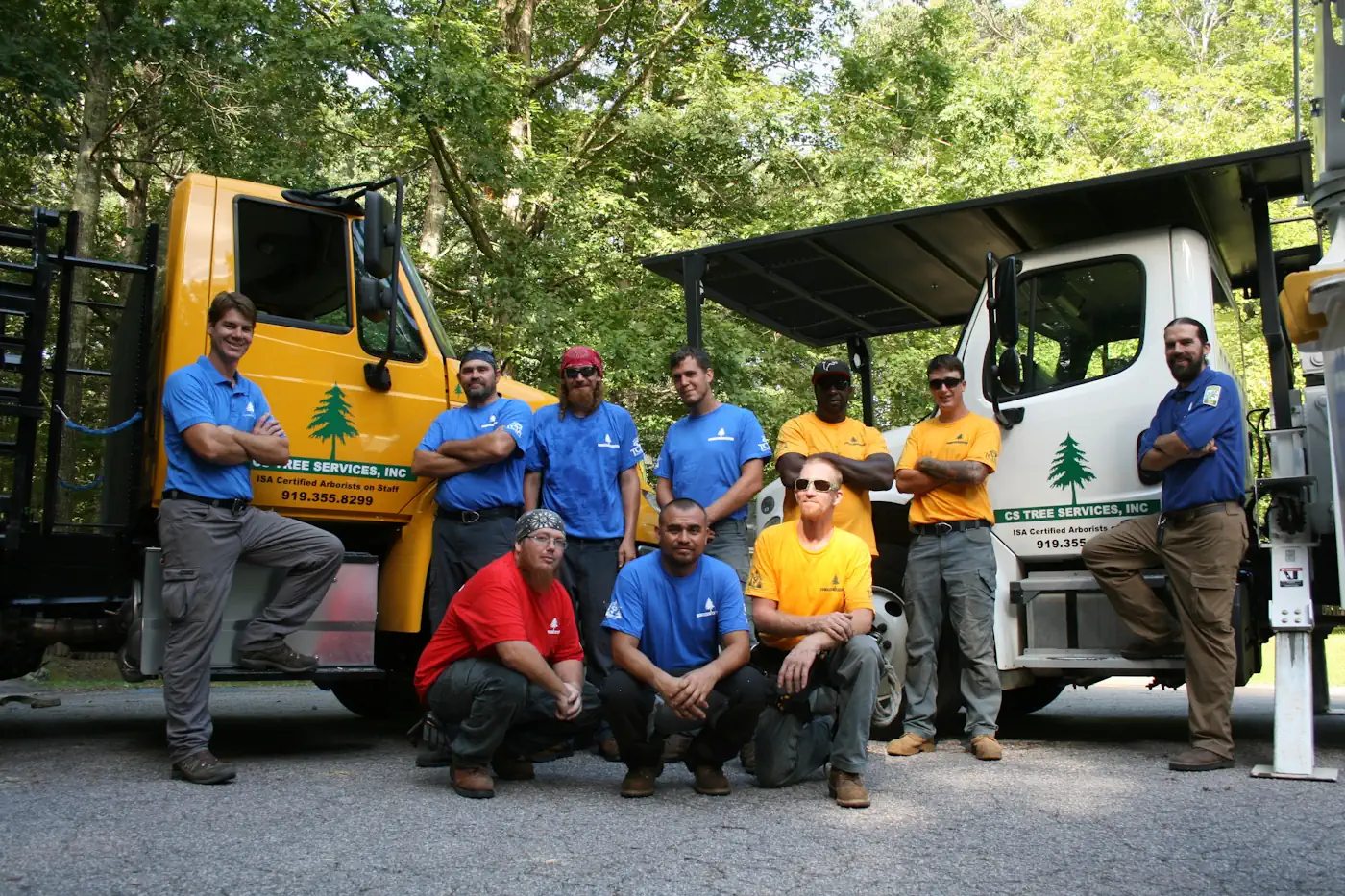
Want to know more about the people behind the work? Meet the CS Tree Services team.